
How Much Does a Water Softener Cost Installed in New Mexico?
A water softener costs about $1,100 to $3,000 installed in one national cost guide. That guide puts the national average at $2,500, for a dual-tank system in a 3 to 4 bedroom home. Two other guides put the typical install near $1,500.
These are market numbers from published cost guides, not our price list. In New Mexico, the price turns on how hard your water is and whether you are on a well. Where the softener can drain matters too. Our water softener installation page covers how we size and install a softener.
How much does each type of water softener cost?
Two national cost guides price softeners by type. Each figure below is an installed price.
| System type | Installed, one guide | Installed, another guide |
|---|---|---|
| Salt-based, single tank | $1,200 to $3,800 | $500 to $1,700 |
| Salt-based, dual tank | $1,700 to $5,000 | $1,000 to $5,000 |
| Salt-free conditioner | $1,500 to $4,500 | $800 to $4,000 |
| Magnetic | $2,000 to $6,000 | $200 to $600 |
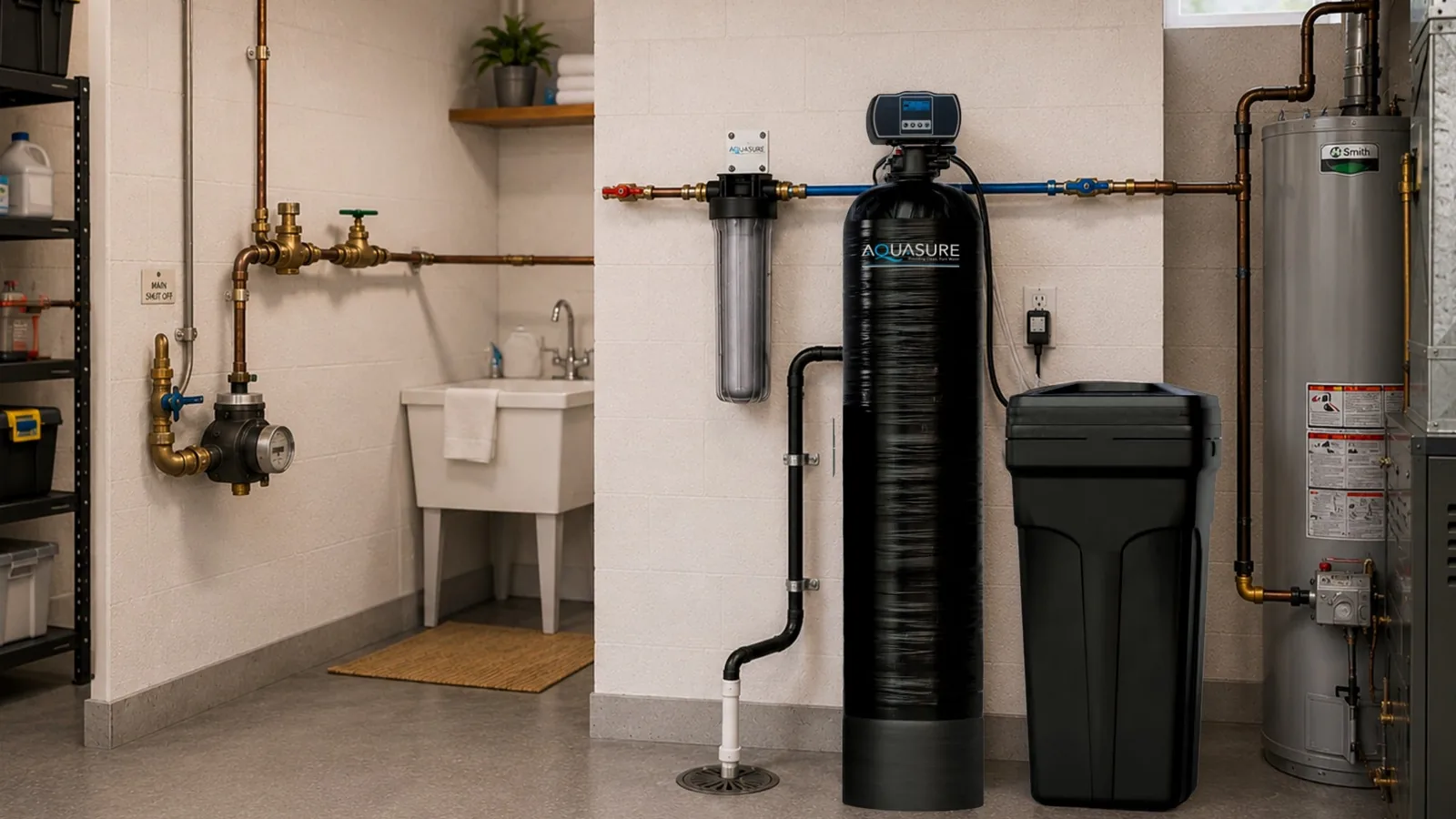
A salt-based softener trades the calcium and magnesium in hard water for sodium. A dual-tank unit has two resin tanks that take turns, so you keep soft water while one regenerates. We install whole-house salt-based softeners with a mineral tank, a brine tank, a control head and a bypass valve.
A salt-free conditioner is a different product, and so are magnetic and electronic units. One guide says a salt-free unit keeps minerals from forming scale but does not technically soften water.
The magnetic row is far apart because one guide prices a whole-house unit it calls a magnetic water distiller. The other notes some debate about how well magnetic units work. Reverse osmosis, listed in some tables, is a filtration system and a separate job.
How much does a water softener cost by grain capacity?
Capacity is how many grains of hardness a softener removes between regenerations. One national guide prices the unit alone by capacity, before labor, materials and disposal. A second guide’s table runs from 32,000 to 96,000 grains, at $400 to $2,500 for the unit.
| Capacity | Unit only, one national guide |
|---|---|
| 24,000 grains | $300 to $500 |
| 32,000 grains | $400 to $1,000 |
| 48,000 grains | $600 to $1,200 |
| 64,000 grains | $800 to $1,500 |
| 80,000 grains | $1,500 to $1,800 |
To size a softener, one guide multiplies your daily water use in gallons by your hardness in grains per gallon. It then multiplies by 3 to 7, the days you want between regenerations.
Its example is 400 gallons a day at 20 grains, or 8,000 grains of removal a day. On a 4 day cycle, that calls for a 32,000 grain unit. On a well, another guide estimates use at 75 gallons per person per day.
Your water report may list hardness in parts per million. Albuquerque’s Water Authority says to divide ppm by 17.1 to get grains per gallon. For example, 171 ppm works out to 10 grains per gallon.
What does installation labor add?
One national guide puts installation labor at $150 to $1,000, depending on the system size and type. It says some systems cost $3,000 to install when they need their own circuit and pipe connections.
Softeners usually go near the water main, and most need a drain for the backwash. Homes that already have a soft water loop need less work, another guide says. A new drain line or a rerouted water line adds to the cost. These add-ons come up most, with figures from national cost guides:
- A softener loop, when the house has none: $600 to $2,000, installed with the softener.
- New pipe to reach the spot: $0.50 to $8 per linear foot.
- A dedicated electrical circuit, when the system needs one: $250 to $900. A licensed electrician handles that part.
- A permit, where one is required: usually $20 to $100.
- Hauling off the old unit on a replacement: $50 to $100.
Swapping out an old softener costs less, $700 to $1,000 in one guide, since the plumbing is usually in place. A leak or failing pipe where the softener ties in is plumbing repair, a separate job.
What changes the cost in New Mexico?
Hard water. Albuquerque’s Water Authority says its water ranges from moderately hard to hard, depending on the source and blend. One national guide says moderately hard water, at 3.5 to 7 grains per gallon, may benefit from softening. It recommends softening for hard water at 7 to 10 grains.
The same guide says extremely hard water may need a larger unit or more frequent regeneration. Both raise equipment and operating costs.
White bits that clog your fixtures may be calcium carbonate scale from the water heater, the Water Authority says. If so, you probably need to flush your water heater, and our water heater maintenance page covers that.
Wells and septic. Many East Mountains homes run on a well and septic. One guide puts a typical well water softener at $500 to $2,000. It says most wells can use an ion exchange unit. Other chemicals in the well water may call for an additional system, the guide adds.
Test the water before you buy. A home test kit runs $20 to $50 in one guide. Another puts a basic hard water test at $130 to $200. If the test shows sediment, we can add a sediment pre-filter ahead of the softener.
New Mexico’s liquid waste rule lets softener waste go to a conventional septic system. On new construction with an advanced treatment system, softener waste must bypass the treatment unit. It goes to the drainfield or another approved disposal, which can mean a separate drain run. Our septic system installation page covers new systems.
Cold. Water softeners are on our list of storm-season calls, along with frozen pipes and slab leaks. One national guide says softeners are built for interior use only and are not designed for freeze and thaw cycles. A softener in an unheated garage or well house needs the same freeze protection as the pipes around it. Our frozen pipe repair page covers lines that split.
What does a water softener cost to run each year?
One national guide puts salt or potassium at $50 to $150 a year. A 40-pound bag of salt runs $5 to $10 in two guides. Potassium costs more, at $25 to $50 a bag in one.
That first guide puts maintenance at $100 to $300 or more a year. Another says to check the brine tank every three to four months to prevent salt buildup.
A softener lasts 15 to 20 years with proper maintenance in one guide. Another puts it at roughly 10 to 15 years.
How do you get a price for your own house?
The national ranges are wide because every house starts with different water and plumbing. We look at your water source and where the softener can tie in and drain. Then we size the unit to your hardness and household, and you get a free estimate before any work starts.
Wright Flow Plumbing and Heating is based in Edgewood and works across Albuquerque, Rio Rancho, Corrales and the East Mountains. Call (505) 306-8285 and tell us what you have now. Our water softener installation and repair page covers the install itself and units that already act up.