
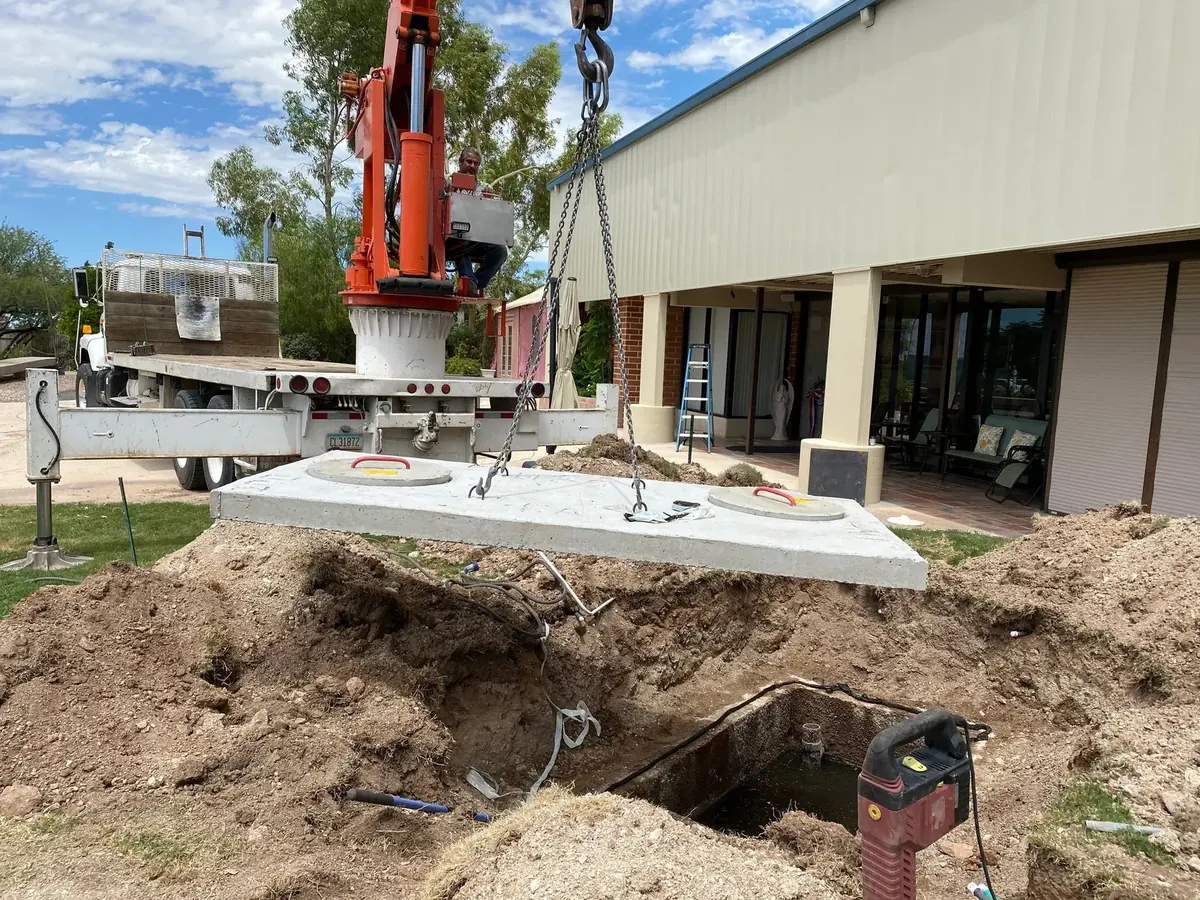
Concrete vs Plastic Septic Tank: Which Is Better in New Mexico?
Neither material wins on every lot. Concrete has the edge where groundwater runs high, because its weight helps keep it from floating. Plastic has the edge where a heavy truck cannot get close to the hole. The Environmental Protection Agency (EPA) says both can last for decades, so your lot usually decides.
The tank prices overlap too. Tank only, national cost guides put plastic at about $500 to $2,500 and concrete at about $700 to $3,000. Those are market numbers, not our price list. The tank is one part of a septic system installation, and your groundwater and access decide which material fits.
What septic tanks does New Mexico allow?
The state rule, 20.7.3 NMAC, allows precast reinforced concrete, poured in place concrete, fiberglass and polyethylene tanks. Other materials need written approval from the New Mexico Environment Department (NMED). Metal, wooden, concrete block and homeowner built tanks are prohibited.
The model matters too. NMED will not issue a permit for a tank it has not reviewed and approved before installation. It publishes the approved list by manufacturer, by certification number and by capacity, and each design is renewed every year.
Whatever the material, every tank has to:
- Hold up to earth pressure from saturated soil with the tank empty.
- Carry a live load of at least 300 pounds per square foot under three feet of cover.
- Stay watertight, without excessive corrosion or decay.
- Be protected against flotation in high groundwater and floodplains.
- Permanently show the maker’s name, New Mexico registration number, year built and capacity in gallons above the outlet pipe.
Each tank also needs at least two access openings of 20 inches or more, with secure lids at the surface. Risers are 24 inches across for tanks down to three feet deep. Deeper tanks need risers at least 30 inches across. Concrete risers need an NMED approved coating.
How do concrete, plastic and fiberglass septic tanks compare?
Prices are market ranges for the tank alone, before installation. The float and crack notes come from a national cost guide, and the weights from product spec sheets.
| What to compare | Concrete | Plastic (polyethylene) | Fiberglass |
|---|---|---|---|
| NMED status | Allowed, precast or poured in place | Allowed, installed by the maker’s instructions | Allowed, installed by the maker’s instructions |
| Weight and handling | 8,760 pounds for one 1,000 gallon tank; heavy equipment to set | Under 400 pounds for one 1,000 gallon tank; easy to handle | Varies by model |
| Flotation | Weight holds it down near the water table | May float up near the water table | Can float or shift near the water table |
| Cracking or deformation | Prone to cracking; hard to repair | Resists cracking; heavy loads can change its shape | Stronger than plastic |
| Lifespan | 50 years or more (EPA) | Similar to concrete (EPA) | 30 to 40 years (one cost guide) |
| Tank price, market range | About $700 to $3,000 | About $500 to $2,500 | About $1,200 to $2,000 |
Which tank holds up better where groundwater runs high?
New Mexico’s rule requires every tank, concrete included, to be protected against flotation under high groundwater and in floodplains. Still, a national cost guide says a heavy concrete tank will not float when the water table is near it. It says a light plastic tank may float upward.
Plastic makers set their own limits. One maker’s installation guide says never to install its tank in an area with a high water table. The cost guide gives fiberglass a similar warning: it can float or shift.
If your lot sits low near the Rio Grande, ask about groundwater before you pick a tank. Under the state rule, a septic test hole is dug partly to find the seasonal high water table. If your site has one, weigh that reading when you choose.
Will a concrete tank crack, or a plastic tank bend?
Each material fails in its own way. The same cost guide calls concrete prone to cracking and seepage, and hard to repair once damaged. It says plastic resists cracking, but heavy weight over the tank can change its shape. EPA adds that older concrete tanks may not be built as well as newer ones.
A cracked or leaking tank is septic system repair work. Under NMED’s rule, a minor structural correction to a tank counts as a repair. Replacing the tank counts as a modification, and the permit has to be in hand before work starts.
How do the install rules differ for concrete and plastic?
The state rule treats the two differently. A concrete tank sits level on undisturbed or compacted soil, or on 1/4 to 3/4 inch pea gravel or sand. Its walls are at least two and a half inches thick, with floors and covers of three inches. A poured in place tank has to be designed and signed off by a professional engineer.
Plastic and fiberglass tanks go in by the maker’s instructions, kept on site for NMED to inspect. One plastic tank maker’s guide calls for a compacted sand and gravel bed under the tank. The minimum is 6 inches in soil and 12 inches in rocky terrain. Its sand and gravel backfill goes in evenly on all sides, with water added to balance the pressure.
Instructions vary by model, though. Another plastic tank’s product page says it needs no special backfill or water filling. On a rocky East Mountains lot, bedding sand and gravel may have to be hauled in.
Which tank is easier to get onto your lot?
Weight is the plainest difference. One precaster’s spec sheet lists a 1,000 gallon one piece concrete tank at 8,760 pounds with its lid. A product spec sheet puts a 1,000 gallon two compartment plastic tank under 400 pounds. The concrete tank weighs more than 20 times as much.
The same national cost guide says concrete takes heavy equipment to haul and set, while plastic is easy to handle. On a steep or tight East Mountains lot, getting a heavy truck near the hole can be the hard part.
When should you choose concrete, and when plastic?
Start with the site evaluation and the access. The material follows from those two.
Concrete usually makes sense when:
- The test hole shows a high seasonal water table, or the lot sits in a floodplain.
- Heavy delivery equipment can get close to the hole.
Plastic usually makes sense when:
- The drive is steep or remote, and a light tank is far easier to set.
- The ground stays dry, and the maker’s bedding and backfill rules can be met.
Fiberglass is a third choice, with the same float warning as plastic. Another cost guide says it tends to cost the most of the three.
How do we help you choose and install the tank?
Wright Flow Plumbing and Heating is based in Edgewood and installs and repairs septic systems. We work across Albuquerque, Rio Rancho, Corrales and the East Mountains. We look at the lot and what NMED will permit, then explain the tank options. We handle the permit paperwork with you.
Our septic system installation page covers the work itself. For whole-system prices, see the full septic system cost guide. Call (505) 306-8285 for a free estimate.